Tuesday, September 11, 2007

Technology flashback to 1967... (updated)

This is very cool... a look back at how some futurists were thinking life would be in 1999.

From the 1967 film 1999 A.D. in which we see the family of the future shopping, paying bills and using electronic mail from home:


What the wife selects on her console will be paid for by the husband at his counterpart console.

That's wild how right they got it... more here.

(Hat tip AP... "Amazon, the early years" indeed. )

So how about technology for our future? How about replacing our dependency on oil... with an ability to use water for fuel! Now that's awesome.

Update: Some cool technology that's available today? OK... this is insane:


The Onion has a solution:

Labels: , , ,

Tuesday, January 16, 2007

Amazing pictures from 'A Crowded Womb'...

From the Daily Mail:
A twin leans over and kisses the cheek of her sister in a heart-warming picture that would not be out of place in any family home.

Yet these siblings are a not even born and the astonishing images have been captured on a new 'four-dimensional' ultrasound scan of the womb. ...

... The new 4D scan us ses the same frequency of sound waves w as in a normal ultrasound. But the sound waves are directed from many more angles, producing a 'real-time' video of the foetus as it moves and allowing scientists to say the images are in four dimensions.

This advanced technology has allowed scientists to capture the development of foetuses like never before, including twins and triplets jostling for space in the womb while grasping each other's hands and even faces.
Amazing.

Now, a funny reminder of how we got here from our friends at South Park.

Go Ms. Garrison!:

Labels: , ,

Thursday, August 31, 2006

Waiting for the bomb to drop...

... but where?

The Intellectual Activist

Five Minutes to Midnight, by Robert Tracinski
... Observing the events of today—the hesitation and uncertainty, the stubborn clinging to the fantasy that the enemy can be appeased if we just keep talking and find the right diplomatic solution—I now feel that, for the first time, I really understand the leaders of the 1930s. Their illusion that Hitler could be appeased has always seemed, in historical hindsight, to be such a willful evasion of the facts that I have never grasped how it was possible for those men to deceive themselves. But I can now see how they clung to their evasions because they could not imagine anything worse than a return to the mass slaughter of the First World War. They wanted to believe that something, anything could prevent a return to war. What they refused to imagine is that, in trying to avoid the horrors of the previous war, they were allowing Hitler to unleash the much greater horrors of a new war.

Today's leaders and commentators have less excuse. The "horror" they are afraid of repeating is the insurgency we're fighting in Iraq—a war whose cost in lives, dollars, and resolve is among the smallest America has ever had to pay. And it takes no great feat of imagination to project how much more horrible the coming conflict will be if we wait on events long enough for Iran to arm itself with nuclear technology. Among the horrific consequences is the specter of a new Holocaust, courtesy of an Iranian nuclear bomb.

The good news, such as it is, is that the air of foreboding about this new war is somewhat exaggerated. Yes, the conflict will become larger and bloodier—far bloodier than it would have been had we acted earlier. But Iran is not Nazi Germany—a large, united, economically and technologically advanced nation that could nearly equal our military capability. Iran is a poor, backward nation with a large, restive dissident movement. Its military bluster is a hollow shell hiding its underlying weakness. It's time to break that shell and kill the monster inside—before it grows any bigger and more powerful.

We can all sense that the war is coming. It is vital for America to seize the initiative and fight it on our terms, when we have the maximum advantage.

It's five minutes to midnight. The time to strike Iran is now.
War for oil... or for freedom? Who is the enemy?

The one thing that stuck with me from the recent debriefings of Centanni and Wigg was the notion from their captors that all of the war and conflict could be avoided if we would simply convert to Islam.

There it is. That is what we're up against. That is the evolving threat that we are facing and need to answer on behalf of our children: do we stand up for western values of freedom, equality, democracy, etc... or do we sit down and hope that the threat isn't real and that we won't one day be forced at gunpoint to convert to Islam and Islamic Law.

If not now, when? If not us, who? If it's not real, what is it?

Are we willing to face the real "inconvenient truth"?
... The West better decide on the answers to the questions or be prepared to live under Shariah Law in a totalitarian Islamic state. The question that has to be answered is: Would you choose appeasement and wind up as a lampshade in a palace or fight for Western democracy, freedom and liberty? ...
Help.

Labels: , ,

Friday, June 09, 2006

The Art of Aerial Assassination...

David Axe:
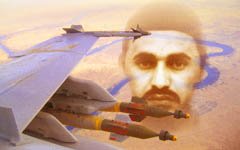
For years, the military has labored to increase the flexibility and lethality of its aircraft and to decrease the time it takes to put bombs on target. One goal has been to "decapitate" regimes and terrorist organizations with timely air strikes. Several decapitation strikes since 2003 have failed despite increasingly sophisticated weapons and sensors, due to intelligence failures.

On Wednesday, the military succeeded in killing Al Qaeda leader Abu Musab Al Zarqawi with an air strike on his Baqubah, Iraq, safehouse. For the first time in more than four years, intelligence has allowed the technology of aerial assassination to fulfill its potential...
The rest...here.

-Home-

Labels: ,

Monday, March 27, 2006

American Creativity, Leadership, Competitiveness, Talent...Innovation is the key

President George W. Bush, May 2001:
"The role of government is not to create wealth; the role of our government is to create an environment in which the entrepreneur can flourish, in which minds can expand, in which technologies can reach new frontiers."
-Home-

Labels: ,

Friday, March 17, 2006

The Discovery of Noah's Ark? That would change everything...


According to press materials supplied by Shamrock - The Trinity Corporation,
this satellite view shows Noah's Ark jutting out from the snow on Mt. Ararat.
Image Courtesy of Digital Globe


Click here to read more in a recent article (3/9/2006) by David Leonard on Space.com.

(Previous articles by David Leonard... from 2001 here, from 2002 here)

The pictures...and the technology that allows us all to view the site...are absolutely amazing, regardless of whether or not you want to believe that this really could be the Ark or not.
High on Mt. Ararat in eastern Turkey, there is a baffling mountainside "anomaly," a feature that one researcher claims may be something of biblical proportions.

Images taken by aircraft, intelligence-gathering satellites and commercial remote-sensing spacecraft are fueling an intensive study of the intriguing oddity. But whether the anomaly is some geological quirk of nature, playful shadows, a human-made structure of some sort, or simply nothing at all—that remains to be seen.

Whatever it is, the anomaly of interest rests at 15,300 feet (4,663 meters) on the northwest corner of Mt. Ararat, and is nearly submerged in glacial ice. It would be easy to call it merely a strange rock formation.

But at least one man wonders if it could be the remains of Noah's Ark—a vessel said to have been built to save people and selected animals from the Great Flood, the 40 days and 40 nights of deluge as detailed in the Book of Genesis.

The Genesis blueprint of the Ark detailed the structure as 6:1 length to width ratio (300 cubits by 50 cubits). The anomaly, as viewed by satellite, is close to that 6:1 proportion.

Newfound optimism

Identifying the Ararat anomaly has been a 13-year-long quest of Porcher Taylor, an associate professor in paralegal studies at the University of Richmond's School of Continuing Studies in Virginia.

Taylor has been a national security analyst for more than 30 years, also serving as a senior associate for five years at the Center for Strategic and International Studies (CSIS) in Washington, D.C.

"I've got new found optimism ... as far as my continuing push to have the intelligence community declassify some of the more definitive-type imagery," Taylor told SPACE.com/LiveScience. He points to a "new and significant development," a high-resolution image taken by DigitalGlobe's impressive QuickBird satellite and shown here publicly for the first time [alternate version with no annotation].

"I'm calling this my satellite archeology project," Taylor said. It's an effort that has now included use of QuickBird, GeoEye's Ikonos spacecraft, Canada's Radarsat 1, as well as declassified aerial and satellite images taken by the various U.S. intelligence agencies.

Making the mountain transparent

Taylor said his goal is straightforward: Combining this imagery to make the Ararat anomaly transparent to the public, as well as to the discerning, dispassionate eyes of scientists, imagery analysts, and other experts.

"I had no preconceived notions or agendas when I began this in 1993 as to what I was looking for," Taylor said.

As for the saga of Noah's Ark, he is quick to note that there are those who say it is fable while some take it as truth.

Nevertheless, the anomaly may not be a ridge line of ice, snow and possibly rock, but an artificial ridge line, Taylor said. "I maintain that if it is the remains of something manmade and potentially nautical, then it's potentially something of biblical proportions."


I maintain that if it is the remains
of something manmade and potentially nautical,
then it's potentially
something of biblical proportions


While chiding the intelligence communities to release more of their closely guarded satellite imagery, Taylor said that soon-to-fly commercial remote sensing spacecraft are sure to help his archeological undertaking.

"We've got three new birds that are going up. I'm using all my clout, rapport and lobbying to, hopefully, have them at least fly calibration runs over Mt. Ararat," Taylor said. Those images would make the mountain even more transparent, he said.

Will it float?

Meanwhile, Taylor has an ever-expanding network of experts to help tease out the truth about the anomaly.

For example, satellite imagery analyst Rod Franz of SunTek Media Group/RiteImage, Inc., located in Henderson, Nevada, has taken a look at imagery provided by Taylor of the Ararat anomaly and carried out additional analysis of the area. As director of training for the firm, Franz sharpened his skills by serving nearly 25 years as a military intelligence imagery analyst.

For the anomaly assessment, the same software tools used for studying government and commercial remote sensing data were employed, Franz told SPACE.com / LiveScience. Ground distances and scales of the anomaly were determined. That software also has the ability to adjust brightness, haze, sharpness, contrast and other factors of the area of interest, he said.

"Along with many other image manipulation functions ... I also used the pseudo-color function trying to determine if I could detect anything under the ice and snow," Franz said.

The face of the anomaly measured 1,015 feet (309 meters) across, Franz said. "I also found the shape of the anomaly appears to fit on a circle. I am not sure what this means, if anything, but I find it curious."

Given that length, Taylor pointed out, the anomaly dwarfs the Titanic and Bismarck in size, and equals the size of the largest modern aircraft carrier. That analysis would seem to call into question whether the anomaly is a wooden ship and raises a key question: If a boat were truly that huge, would it float?


the anomaly dwarfs the Titanic
and Bismarck in size, and equals the size of
the largest modern aircraft carrier


There are also experts in remote sensing who offer a skeptical view.

"Image interpretation is an art," said Farouk El-Baz, Director of the Boston University Center for Remote Sensing.

"One has to be familiar with Sun lighting effects on the shape of observed features," El-Baz said. "Very slight changes in slope modify shadow shapes that affect the interpretations. Up to this time, all the images I have seen can be interpreted as natural landforms. The feature that has been interpreted as the 'Ararat Anomaly' is to me a ledge of rock in partial shadow, with varied thickness of snow and ice cover.

Visual truth serum

Thanks to more satellite imagery in the offing, as well as other studies underway, Taylor said his remote archeological research is on the upswing.

There is an ultimate end-game. That is, on-the-spot ground truth ... and Taylor hopes his research findings will catalyze a top-notch expedition to the area. "It is whatever it is," he said.

But for now, satellite remote sensing to carry out archeological "digs" from space will fill in for an in-the-field expedition.

Just a few weeks ago, for example, NASA scientists utilizing space- and aircraft-based remote sensing hardware and techniques uncovered Maya ruins hidden in the rainforests of Central America for more than 1,000 years.

"For explorers, imagery from GeoEye's Ikonos satellite married with Global Positioning System (GPS) satellite data has become as indispensable as water and freeze dried food for any expedition. One does not want to leave home without it," said Mark Brender, GeoEye Vice President for communications and marketing, headquartered in Dulles, Virginia.

For researchers, imagery from space like those provided by GeoEye provides "the ultimate high shot" and a contextual view you could never get from observations on the ground or even from a plane, Brender told SPACE.com/LiveScience. "It's visual truth serum."
Daniel P. McGivern is another person to know about in this search. He hopes to take a joint U.S.-Turkish team of 10 explorers on an arduous trek up Turkey's tallest mountain...17,820 feet...subject to the approval of the Turkish government.
"We are not excavating it. We are not taking any artifacts. We're going to photograph it and, God willing, you're all going to see it"
Click here for a 1997 Washington Times article by Bill Gertz

Home

Labels: ,

Thursday, February 23, 2006

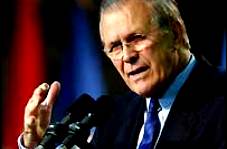
Don Rumsfeld: "War in the Information Age"


Donald Rumsfeld
writes in todays
L.A. Times...
(hyperlinks are mine)
Click here to read.

"OUR NATION IS engaged in what promises to be a long struggle in the global war on terror. In this war, some of the most critical battles may not be in the mountains of Afghanistan or the streets of Iraq but in newsrooms in New York, London, Cairo and elsewhere.

Our enemies have skillfully adapted to fighting wars in today's media age, but for the most part we — our government, the media or our society in general — have not...

...I believe with every bone in my body that free people, exposed to sufficient information, will, over time, find their way to the right decisions.

We are fighting a battle in which the survival of our free way of life is at stake. It is a test of wills, and it will be won or lost with our public and the publics of free nations around the world. We need to do all we can to correct the lies being told, shatter the appeal of the enemy and attract supporters to our noble and necessary efforts to defeat violent extremism around the globe."


Donald Rumsfeld is right, and deserving of respect and admiration:

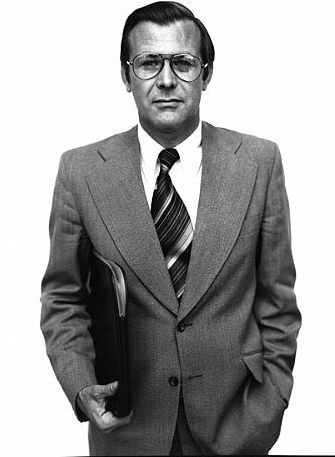
Donald H. Rumsfeld was sworn in as the 21st Secretary of Defense on January 20, 2001. Before assuming his present post, the former Navy pilot had also served as the 13th Secretary of Defense, White House Chief of Staff, U.S. Ambassador to NATO, U.S. Congressman and chief executive officer of two Fortune 500 companies.

Secretary Rumsfeld had directed the actions of the Defense Department in response to the terrorist attacks on September 11, 2001. Thus far, the Global War on Terror has resulted in the liberation of 25 million Afghanis and 27 million Iraqis, with free elections in both of those nations. Two-thirds of known Al Qaeda leaders have been captured or killed.

The war is being waged against a backdrop of major change within the Department of Defense. The department has developed a new defense strategy and replaced the old model for sizing forces with a newer approach more relevant to the 21st century. Secretary Rumsfeld proposed and the President approved a significant reorganization of the worldwide defense command structure, known as the Unified Command Plan, which resulted in the establishment of the U.S. Northern Command and the U.S. Strategic Command, the latter charged with the responsibilities formerly held by the Strategic and Space Commands which were disestablished. U.S. special operations forces have been expanded and the conduct of special operations has been more closely integrated into contingency planning. He has also initiated a global restructuring of U.S. forces to better reflect the realities of the post-Cold War period, including significant shifts of forces from Europe and the Korean peninsula. The Department of Defense has developed a new model for civil service, known as the National Security Personnel System. Additionally, Secretary Rumsfeld will oversee what could be the largest round of base readjustments in U.S. history, ensuring that scarce resources are available for needed combat capabilities.

Mr. Rumsfeld attended Princeton University on academic and NROTC scholarships (A.B., 1954) and served in the U.S. Navy (1954-57) as an aviator and flight instructor. In 1957, he transferred to the Ready Reserve and continued his Naval service in flying and administrative assignments as a drilling reservist until 1975. He transferred to the Standby Reserve when he became Secretary of Defense in 1975 and to the Retired Reserve with the rank of Captain in 1989.

In 1957, he came to Washington, DC to serve as Administrative Assistant to a Congressman. After a stint with an investment banking firm, he was elected to the U.S. House of Representatives from Illinois in 1962, at the age of 30, and was re-elected in 1964, 1966, and 1968.

Mr. Rumsfeld resigned from Congress in 1969 during his fourth term to join the President's Cabinet. From 1969 to 1970, he served as Director of the Office of Economic Opportunity and Assistant to the President. From 1971 to 1972, he was Counsellor to the President and Director of the Economic Stabilization Program. In 1973, he left Washington, DC, to serve as U.S. Ambassador to the North Atlantic Treaty Organization (NATO) in Brussels, Belgium (1973-1974).

In August 1974, he was called back to Washington, DC, to serve as Chairman of the transition to the Presidency of Gerald R. Ford. He later became Chief of Staff of the White House and a member of the President's Cabinet (1974-1975). He served as the 13th U.S. Secretary of Defense, the youngest in the country's history (1975-1977).

From 1977 to 1985 he served as Chief Executive Officer, President, and then Chairman of G.D. Searle & Co., a worldwide pharmaceutical company. The successful turnaround there earned him awards as the Outstanding Chief Executive Officer in the Pharmaceutical Industry from the Wall Street Transcript (1980) and Financial World (1981). From 1985 to 1990 he was in private business.

Mr. Rumsfeld served as Chairman and Chief Executive Officer of General Instrument Corporation from 1990 to 1993, a leader in broadband transmission, distribution, and access control technologies. Until being sworn in as the 21st Secretary of Defense, Mr. Rumsfeld served as Chairman of the Board of Gilead Sciences, Inc., a pharmaceutical company.

Before returning for his second tour as Secretary of Defense, Mr. Rumsfeld chaired the bipartisan U.S. Ballistic Missile Threat Commission, in 1998, and the U.S. Commission to Assess National Security Space Management and Organization, in 2000.

While in the private sector, Mr. Rumsfeld's civic activities included service as a member of the National Academy of Public Administration and a member of the boards of trustees of the Gerald R. Ford Foundation, the Hoover Institution at Stanford University, and the National Park Foundation, and as Chairman of the Eisenhower Exchange Fellowships, Inc.

In 1977, Mr. Rumsfeld was awarded the nation's highest civilian award, the Presidential Medal of Freedom.

Other honors include:
  • Eagle Scout Award (1947)
  • All Navy Wrestling Champion (1956)
  • George C. Marshall Medal by the U.S. Army Association (1984)
  • Woodrow Wilson Medal by Princeton University (1985)
  • Dwight D. Eisenhower Medal (1993)
  • Lone Sailor Award by the U.S. Navy Memorial Foundation (2002)
  • Statesmanship Award by the U.S. Assoc of Former Members of Congress (2003)
  • James H. Doolittle Award by the Hudson Institute (2003)
  • Ronald Reagan Freedom Award by the Reagan Library (2003)
  • Gerald R. Ford Medal presented by President Ford and the Ford Foundation (2004)

    Mr. Rumsfeld has been awarded 11 honorary degrees.

  • The Left is wrong with their caricatures of him.

    Right Wing News has their favorite Rumsfeld quotes here.
    "Don't divide the world into "them" and "us." Avoid infatuation with or resentment of the press, the Congress, rivals, or opponents. Accept them as facts. They have their jobs and you have yours."

    Labels: , , ,